AC-30荧光模型常见于无明显自身免疫性疾病的个体。但是,由于该模型可能反映多种抗核抗体的联合反应性,因此偶尔也可见于患有系统性自身免疫性风湿病的患者,特别是在存在多种抗核抗体的情况下(2, 5)。

| 简体中文 | ||
| 同义词 | 假性-DFS(1); 细颗粒伴有丝分裂板型 | Pseudo-DFS [1]; Nuclear Speckled with Positive Metaphases; Nuclear Homogeneous Speckled; Nuclear Homo/Speckled. |
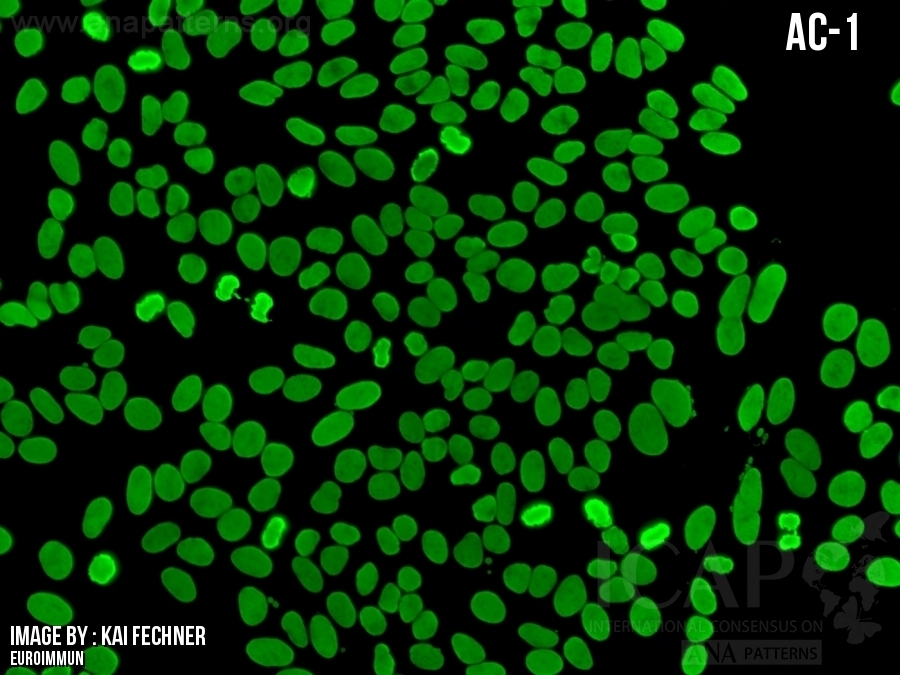
| 描述 | 斑点型荧光核型均匀分布于整个间期细胞核,在斑点的大小、亮度和分布上均表现出均一性。在中期极(染色体板)上也可观察到类似的斑点模型。但是,若同时存在核斑点型荧光而且中期极带有均质(透明)纹理,则应归类为混合型核荧光模型(混合型),而非AC-30(2, 3)。 | The speckled staining pattern is uniformly distributed throughout the interphase nucleus, exhibiting homogeneity in speckle size, brightness, and distribution. A similar speckled pattern is observed in the metaphase plate. Importantly, a nuclear speckled pattern with the metaphase plate with a homogeneous (hyaline) texture should be classified as a mixed nuclear pattern and not as AC-30 [2, 3]. |
| 抗原相关性 | AC-30样本通常不伴有已知的自身抗体。但是,AC-30模型也可能由多种临床相关自身抗体共同存在而产生,特别是靶抗原为dsDNA、核小体、Sm、U1-RNP、Scl-70/topo-I、SS-A/Ro60(先前称为SS-A/Ro60 (4)和/或SS-B/La的抗体。两种或多种上述抗体的共存可能会干扰其各自特征性模型的表达,从而导致AC-30模型的出现。因此,AC-30可被视为混合模型的一种特定情况。除此之外,部分AC-30样本含有抗DFS70抗体与其他抗核抗体的组合,这种组合可能掩盖典型的抗DFS70相关AC-2模型。 | AC-30 samples frequently do not exhibit a known autoantibody. However, the AC-30 pattern can also arise from the concurrent presence of multiple clinically relevant autoantibodies, particularly those targeting dsDNA, nucleosomes, Sm, U1-RNP, Scl-70/topo-I, SS-A/Ro60 (formerly known as SS-A/Ro60 [4]), and/or SS-B/La. The coexistence of two or more of these antibodies may interfere with the expression of their individual characteristic patterns, resulting in the AC-30 pattern. In this context, the AC-30 can be considered a specific case of mixed pattern. Additionally, some AC-30 samples contain anti-DFS70 antibodies in combination with other antinuclear antibodies, which can mask the typical anti-DFS70-associated AC-2 pattern. |
-
The AC-30 pattern is commonly observed in individuals without any apparent autoimmune disease. However, since it may reflect the combined reactivity of several antinuclear antibodies, the AC-30 pattern can occasionally be seen in patients with systemic autoimmune rheumatic diseases, especially in cases with multiple antinuclear antibodies [2, 5].
-
二级信息Second level information
-
无无
-
参考文献References
-
无无
FAQ
-
无